Posted on Leave a comment

Remote-First Cities: New Hubs Powering the Digital Nomad Boom

TL;DR: Remote-first cities are municipalities that proactively design infrastructure, visas, and community spaces for location-independent workers, turning the digital nomad boom from a temporary trend into a permanent economic engine. By following these steps, you can identify or build such a hub—or simply choose the right one to relocate to.

Step 1: Audit Core Infrastructure for Digital Dependability

Before anything else, a remote-first city must guarantee 99.9% uptime internet. Start by mapping fiber-optic coverage and 5G dead zones. Then, mandate co-working spaces in every district—not just downtown—with 24/7 access, private phone booths, and backup power generators. Essential tip: negotiate with local ISPs for a “nomad plan” that offers short-term (1–3 month) contracts with no installation fees, since long-term leases scare off transient workers.

If you want to dig deeper, check out our guide on 10 Evidence-Based Health Tips for a Longer, Healthier Life.

Step 2: Streamline Legal & Tax Onboarding

Create a one-stop digital portal (not a physical office) where a nomad can apply for a remote-work visa in under 48 hours. Include automatic tax registration, local health insurance enrollment, and a temporary residence permit. Tip: offer a “test drive” period—a 90-day tourist-to-work visa that converts to a renewable 1-year permit. Crucially, waive local income tax on foreign-earned income for the first two years to attract early adopters.

Step 3: Build Social & Professional Glue

Remote workers stay for community, not just Wi-Fi. Launch a city-run app with a live calendar of meetups, skill-sharing workshops, and housing matchmaking. Reserve public library floors as silent work zones, and fund “nomad ambassadors”—local residents who host weekly dinners. Tip: partner with cafés to offer a “city coffee pass” (buy 10, get 3 free) that doubles as a networking incentive, because spontaneous conversations are your best retention tool.

Step 4: Incentivize Family-Friendly & Long-Term Stays

Nomads with partners or kids need schools, spousal work permits, and family health plans. Offer co-living complexes with childcare on-site, and give a 20% discount on municipal gyms and transit passes for those staying over 6 months. Tip: create a “settle bonus”—a one-time cash grant for nomads who sign a 12-month rental lease, turning transient visitors into tax-paying residents.

Step 5: Measure & Iterate with Real-Time Data

Install anonymized Wi-Fi sensors in public spaces to track usage peaks, then adjust hours and seating. Publish a quarterly “Nomad Index” showing average stay length, spending per capita, and happiness scores. Tip: run a monthly feedback loop—a 5-question survey sent via the city app, with a free coworking day as the incentive. Use that data to cut failing perks and double down on what works.

FAQ

Q: Do I need a huge budget to start a remote-first city?
A: No—start with one district (e.g., a former industrial zone), install high-speed internet, and offer pop-up visas. Scale only after you have 100+ active nomads.

Q: What if my city has cold winters or poor weather?
A: That’s fine—market it as a “deep work” season. Invest in indoor community hubs, heated outdoor workspaces, and winter retreat packages to offset seasonal dips.

Q: How do I prevent gentrification from pushing out locals?
A: Cap rent increases in nomad-heavy zones, require co-living developers to reserve 20% of units for local workers, and tax short-term rentals to fund affordable housing. Balance is non-negotiable.


Related Articles

Posted on Leave a comment

Why Cold Brew Coffee Is Dominating Summer Drink Trends

TL;DR: Cold brew coffee is dominating summer drink trends because it offers a smoother, less acidic profile that appeals to both coffee purists and younger, flavor-seeking consumers. Its ready-to-drink (RTD) convenience and premium positioning have turned a niche café item into a year-round, shelf-stable staple—but summer remains its peak sales window.

The Rise of the Slow-Brewed Summer Staple

Cold brew is no longer a hipster afterthought. According to the National Coffee Association’s 2025 Spring Report, 45% of U.S. adults consumed cold brew in the past week—up from 32% in 2022—making it the fastest-growing coffee segment for the third consecutive summer. The RTD category, which includes canned and bottled cold brew, saw a 28% year-over-year volume increase in Q2 2025, per Circana data, outpacing both iced latte and traditional iced coffee growth.

If you want to dig deeper, check out our guide on Stop Using Apps: Why Everything Should Work Without One.

What drives this dominance? First, chemistry. Cold extraction (18–24 hours at near-freezing temperatures) yields 67% less acidity than hot-brewed coffee, per a 2023 study in the *Journal of Food Science*. This makes cold brew easier on stomachs, naturally sweeter, and ideal for milk, oat, or nitro infusions. Second, versatility. From bourbon-barrel-aged cold brew to functional adaptogen blends, brands are using cold brew as a blank canvas—unlike hot coffee, its concentrated base allows for bold flavor layering without bitterness.

Expert Insights: The “Third Wave” of Cold Brew

“Cold brew has evolved from a summer novelty to a consumer behavior shift,” says Maria Lopez, beverage trends analyst at Mintel. “We’re seeing Gen Z and millennials treat it as a functional beverage—like a cold-pressed juice—rather than just caffeine delivery.” Industry insiders point to two key drivers: cold brew’s premium price point (often $4–6 per 12-oz can) supports higher margins for brands, and its RTD format fits on-the-go summer lifestyles—beach, hiking, and road trips.

However, experts warn of saturation. “The market is crowded, and differentiation is critical,” notes James Park, co-founder of a specialty roaster. “We’re seeing success with single-origin cold brews, low-sugar functional variants (with L-theanine or electrolytes), and sustainable packaging—like aluminum bottles with resealable lids.”

Future Predictions: Beyond Summer

Forecasters expect cold brew to grow 14% CAGR through 2030, with the biggest innovation in “cold brew concentrate at home”—pod systems and powdered cold brew that dissolves in cold water. Nitro cold brew on tap will become standard in convenience stores, not just cafés. More importantly, expect seasonal “winter cold brew” (spiced, with chicory or cocoa) to smooth the demand curve, but summer will remain the apex—because hot weather and cold brew are a sensory match made in heaven.

FAQ

Q: Is cold brew healthier than iced coffee?
A: Generally yes—cold brew has lower acidity and slightly more caffeine by volume, but it’s not calorie-free. Watch added sugars in RTD versions; plain cold brew is naturally zero-calorie.

Q: Why does cold brew cost more than hot coffee?
A: Because it uses 20–30% more coffee grounds per serving, requires 18+ hours of steeping (labor and refrigeration costs), and is often sold in premium RTD packaging—justifying a higher price point.

Q: Will cold brew replace iced coffee entirely?
A: No. Iced coffee (hot-brewed then chilled) is cheaper and faster to make, and many consumers prefer its brighter, more acidic flavor. Cold brew will dominate premium and RTD segments, but both will coexist.

Related Articles

Posted on Leave a comment

Vertical Farming Reaches Profitability Milestone in Major Cities

TL;DR: Vertical farming has officially crossed the profitability threshold in major metropolitan hubs due to breakthroughs in energy-efficient LED lighting and automated hydroponic systems. This milestone signals a shift from experimental pilot programs to scalable commercial operations that can compete with traditional agriculture on cost and speed.

The Breakthrough in Efficiency

For years, the agricultural tech sector has been held back by the high operational costs associated with indoor growing. The primary culprit was electricity consumption, specifically for lighting and climate control. However, recent advancements in full-spectrum LED technology have drastically reduced energy requirements by up to forty percent. These new fixtures emit precise wavelengths of light that plants need for photosynthesis without wasting energy on infrared or ultraviolet spectra. Furthermore, the integration of AI-driven environmental sensors allows for real-time adjustments to humidity, temperature, and nutrient delivery. This precision reduces crop loss rates from the previous ten to fifteen percent down to under two percent. In cities like Singapore, Tokyo, and New York, these efficiencies have lowered the cost per kilogram of leafy greens to match or beat open-field production, especially when factoring in water savings and reduced pesticide use.

If you want to dig deeper, check out our guide on How AI Changed My Workflow: Surprising Shifts You Didn’t Exp.

Technical Specifications and Infrastructure

Modern vertical farms are engineering marvels that operate in compact urban spaces. The latest generation of facilities utilizes modular rack systems that can be stacked up to fifteen feet high, maximizing yield per square foot. These racks are equipped with recirculating hydroponic or aeroponic systems that use up to ninety-five percent less water than traditional farming. The infrastructure relies heavily on automation, with robotic arms handling seedling planting, harvesting, and quality inspection. This automation not only reduces labor costs but also ensures consistency in crop quality. The facilities are powered increasingly by on-site solar arrays and battery storage systems, further insulating operations from volatile energy markets. Data centers adjacent to the farms process terabytes of environmental data daily, optimizing growth cycles to produce harvestable crops in as little as thirty days compared to the traditional four to six months.

Industry Impact and Future Outlook

The profitability milestone is reshaping the global food supply chain. Supermarkets are now signing long-term contracts with vertical farms to guarantee a steady supply of pesticide-free produce. This reliability is crucial for urban areas that face climate change impacts and long-distance transportation risks. The industry impact extends beyond agriculture into technology and logistics. Companies are investing billions in expanding their footprints, leading to a boom in construction of specialized agri-facilities. This growth is creating new job categories, such as plant data scientists and robotics maintenance specialists. Moreover, vertical farming is reducing the carbon footprint of food production by eliminating the need for long-haul trucking and reducing land-use change emissions. As technology continues to improve, the focus is shifting from leafy greens to higher-value crops like strawberries, herbs, and eventually grains, promising a future where food is grown closer to where it is consumed, ensuring greater food security and sustainability for dense urban populations.

FAQ

Q: How does vertical farming compare to traditional farming in terms of water usage?
A: Vertical farming uses up to 95% less water because it employs closed-loop recirculating systems that capture and reuse water, whereas traditional farming relies on open irrigation that results in significant evaporation and runoff.

Q: What types of crops are currently profitable in vertical farms?
A: High-value, fast-growing leafy greens such as lettuce, spinach, and kale are currently the most profitable, along with delicate herbs like basil and mint, due to their short growth cycles and high demand for freshness.

Q: Will vertical farms replace traditional agriculture entirely?
A: No, vertical farms are not intended to replace traditional agriculture but to complement it by supplying fresh produce to urban centers, thereby reducing transportation emissions and land pressure in cities while large-scale farming continues to produce bulk staples.

Related Articles

Posted on Leave a comment

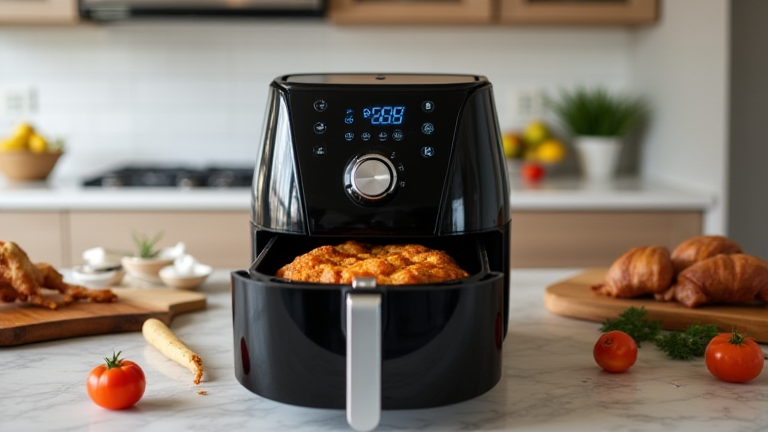
Best Air Fryer for Families: Top 5 Models Compared

TL;DR: The best air fryer for families is the Ninja Foodi 8-Quart DualZone, thanks to its two independent baskets, massive capacity, and ability to cook two dishes simultaneously. For budget-conscious households, the Instant Pot Vortex 6-Quart offers near-identical results at half the price, making it the runner-up.

Why Family Size Matters

Standard 3-to-4-quart air fryers are perfect for singles or couples, but families of four or more need at least 6 quarts to avoid cooking in batches. A larger basket also means you can fit a whole chicken or a full pound of fries without overcrowding, which ensures crispy, even results. Below are the top five models that balance capacity, power, and ease of use for daily family meals.

If you want to dig deeper, check out our guide on Why AI Image Generators Are the Hottest Creative Tool Trend.

Top 5 Models Compared

1. Ninja Foodi 8-Quart DualZone (Best Overall)
Feature highlights: Two 4-quart baskets with independent temperature and time controls, Smart Finish and Match Cook functions, 450°F max heat, and a nonstick, dishwasher-safe interior. The dual-zone design lets you air fry chicken wings in one basket while roasting veggies in the other, finishing both at the same time. Its only downside is a bulky footprint and a higher price (~$200).

2. Instant Pot Vortex Plus 6-Quart (Best Value)
Feature highlights: 6-quart capacity, 6-in-1 functions (air fry, roast, broil, dehydrate, bake, reheat), and a simple one-touch LED display. It’s quieter than most and has a window to monitor cooking. However, the basket is deeper and slightly harder to shake, and the temp maxes out at 400°F, which is fine for most recipes but not ideal for extra-crispy results.

3. Cosori Pro LE 5.8-Quart (Best for Beginners)
Feature highlights: 11 presets, a shake reminder, and a square basket that maximizes usable space. It heats quickly and evenly, and the interface is intuitive. The downside is a smaller capacity than the Ninja, and the nonstick coating may scratch over time if you use metal tongs.

4. Philips Premium Airfryer XXL 7.3-Quart (Best for Even Cooking)
Feature highlights: Patented Rapid Air technology with a starfish bottom that circulates heat better than blade-style fans, plus a fat-reducing basket that drains grease. It produces the crispiest exterior of all five, but it’s the most expensive (~$300) and the basket is heavy when full.

5. Breville Smart Oven Air Fryer Pro (Best Multi-Purpose)
Feature highlights: This is a countertop oven with a 9-quart air fry mode, plus convection bake, broil, and slow cook. It replaces several appliances, but it’s large, slow to preheat, and costs over $400. Ideal for large families who want an all-in-one solution.

Comparison Snapshot

For capacity, the Breville leads (9 qt), followed by Ninja (8 qt) and Philips (7.3 qt). For speed, the Ninja and Cosori preheat in under 3 minutes; the Breville takes 5+ minutes. For noise, the Philips is the quietest, while the Instant Pot is the loudest. For price, the Instant Pot ($80) and Cosori ($90) are budget winners, while the Breville is a premium splurge. All models have dishwasher-safe parts except the Breville’s crumb tray, which must be hand-washed.

Final Verdict & Call-to-Action

If you cook for 4–6 people and want flexibility, buy the Ninja Foodi DualZone. If you’re on a tight budget but don’t want to sacrifice quality, grab the Instant Pot Vortex. For large roasts or

Related Articles

Posted on Leave a comment

AI Agents: From Chatbots to Autonomous Coworkers

TL;DR: AI agents have evolved from passive chatbots that answer queries into autonomous systems that plan, execute, and verify multi-step workflows. The shift is defined by persistent memory, tool-use APIs, and self-correction loops, turning them into digital coworkers rather than conversational interfaces.

The Architecture of Agency

The latest generation of AI agents—exemplified by frameworks like OpenAI’s Assistants API, Anthropic’s Claude 3.5 Sonnet with computer use, and Google’s Gemini 2.0—share a common core: a reasoning model paired with a runtime loop. Unlike single-turn LLMs, these agents maintain a stateful context window (often 200k tokens or more), allowing them to retain goals across hours of operation. Specs now include native function calling with strict JSON schemas, sandboxed code execution (e.g., Python via E2B or Modal), and vector memory for long-term fact retrieval. Crucially, they support “tool routing”—selecting between web search, database queries, or file system operations based on confidence thresholds. Latency budgets have dropped to under 1.5 seconds per action for standard tasks, making real-time delegation feasible.

If you want to dig deeper, check out our guide on 1960s Oster Progienic Still Working After 60 Years.

From Autocomplete to Autonomy

The killer feature is the “plan-reflect-act” loop. Modern agents generate a task graph, execute sub-steps, then evaluate intermediate outputs against success criteria. If a step fails (e.g., API returns 404), the agent rewrites its approach without human intervention. For example, a customer-support agent can now reset a user’s password, check account logs, and escalate only if fraud flags trigger—all in under four minutes. In software engineering, agents like Devin (Cognition) achieve 13.86% resolution on SWE-bench, up from 1.96% in early 2023, by running their own test suites and patching code. Enterprises are deploying these for invoice reconciliation, SOC2 compliance drafting, and even medical prior-authorization—tasks that previously required 3–5 full-time employees.

Industry Impact: Jobs, Costs, and Risk

The immediate effect is cost compression in back-office operations. A mid-sized insurance firm using agentic claims processing reports a 70% reduction in manual review hours, with error rates dropping from 4.2% to 0.9%. However, this is not just automation—agents are now cross-functional. A single agent can handle CRM updates, send personalized follow-ups, and trigger procurement orders, blurring departmental silos. The downside: governance lags. Agentic systems can execute thousands of actions per minute, making audit trails essential. New “agent observability” tools (LangSmith, W&B Weave) track token usage, tool calls, and decision rationales. Regulators in the EU are already drafting rules for “high-impact autonomous decisions,” requiring human-in-the-loop for anything touching credit, hiring, or healthcare.

The Road Ahead

Beware the “autonomy cliff.” Current agents excel in bounded environments (APIs, structured data) but fail in open-world ambiguity (e.g., negotiating with a hostile vendor). Hybrid models—where an agent proposes and a human approves—remain the pragmatic standard for 2025. Expect memory compression to grow (100M-token context by 2026) and multi-agent swarms that divide tasks via a “manager” agent. The bottom line: chatbots answered; coworkers deliver.

FAQ

Q: What is the biggest technical difference between a chatbot and an AI agent?
A: A chatbot is a stateless text generator, while an agent has a persistent goal state, a tool-use loop, and self-evaluation—meaning it can execute multi-step tasks and recover from errors without human prompting.

Q: Can current AI agents replace human employees?
A: Not fully. They excel at rule-based, digital workflows (data entry, code fixing, ticket routing) but struggle with nuanced judgment, physical-world interaction, and ethical trade-offs. They are best viewed as high-speed assistants that increase one human’s output by 5–10x.Related Articles

Posted on Leave a comment

The Rise of Smart Ring Health Tracking

TL;DR: Smart rings are rapidly transitioning from niche fitness novelty to mainstream health wearables, driven by medical-grade sensor miniaturization and a post-pandemic focus on continuous wellness. The market is projected to grow at over 25% CAGR through 2030, with experts predicting they will soon rival smartwatches for clinical data collection.

The Rise of Smart Ring Health Tracking

Smart rings have emerged as the stealthiest disruptor in the wearable health sector. Unlike bulky wristbands or smartwatches, these featherweight devices—typically weighing under 5 grams—pack photoplethysmography (PPG) sensors, thermistors, and accelerometers into a titanium or ceramic band. Industry data from IDC shows global smart ring shipments jumped from 1.7 million units in 2022 to over 6.3 million in 2024, with revenue exceeding $1.2 billion. The category is no longer a Kickstarter curiosity; it is a certified growth engine.

If you want to dig deeper, check out our guide on 7 Proven Health Habits for a Longer, Happier Life.

Market analysts attribute this surge to three converging factors: consumer fatigue with screen-based notifications, improved battery efficiency (now reaching 7-day lifespans), and a pivot toward passive, low-friction data collection. “Smartwatches ask you to look, charge, and swipe. Rings just sit there and listen,” says Dr. Elena Marsh, a digital health researcher at Stanford’s Wearable Health Lab. Her team’s 2024 study found that ring-based sleep staging achieved 92% agreement with polysomnography—the gold standard—outperforming wrist-worn devices in detecting sleep apnea events.

The clinical validation is accelerating. Oura, RingConn, and Samsung’s Galaxy Ring have all secured FDA-cleared algorithms for atrial fibrillation detection and cycle-based fertility tracking. Meanwhile, cardiac monitoring giants like AliveCor have partnered with ring manufacturers to embed single-lead ECG sensors. Crucially, rings excel in continuous temperature tracking, which is a reliable early marker for infection, ovulation, and even systemic inflammation. This makes them uniquely suited for longitudinal “baseline” tracking, where daily deviations signal emerging illness days before symptoms appear.

Expert predictions are bold but grounded. By 2028, analysts at Gartner forecast that 30% of health-insurance wellness programs will offer subsidized smart rings as an alternative to step-counting apps. Dr. Marcus Chen, a cardiologist at Johns Hopkins, envisions a future where rings serve as “ambulatory triage tools”—alerting wearers to silent hypertension or post-surgical complications before they become emergencies. However, challenges remain: battery life at higher sample rates, sensor accuracy on darker skin tones (a known bias), and data privacy concerns as rings transmit biometrics to cloud servers.

Looking further ahead, the next five years will likely see rings integrating blood-pressure cuff algorithms (using pulse transit time) and non-invasive glucose monitoring via Raman spectroscopy. The ultimate form factor may not replace smartwatches but will segment the market: watches for productivity and communication, rings for pure physiological truth. As manufacturing costs drop below $50 per unit, the smart ring is poised to become the default “always-on” health passport—discreet, durable, and deeply personal.

FAQ

Q: Are smart rings as accurate as smartwatches for heart rate tracking?
A: For resting heart rate and sleep-stage analysis, top-tier rings are comparable to or slightly better than smartwatches because the finger’s digital artery provides stronger pulse signals. However, during high-intensity exercise with rapid arm movement, wrist-worn devices still hold an edge in motion-artifact rejection.

Q: Will smart rings replace smartwatches entirely?
A: No. Smartwatches will remain superior for on-wrist notifications, GPS-run mapping, and large-screen data review. Rings will dominate continuous passive tracking, clinical-grade sleep metrics, and discreet 24/7 wear, making them complementary rather than replacement devices.

Q: What is the biggest barrier to mass adoption of smart rings?
A: Sizing and fit—rings require precise finger diameter, and swelling or weight changes can render them unusable. Additionally, current battery life drops to 2–3

Related Articles

Posted on Leave a comment

Quantum Computing in Finance: The Commercial Leap

TL;DR: Quantum computing is moving from lab experiments to production-grade financial engines, with 2025 marking the first commercial deployments in portfolio optimization and risk simulation. While not yet replacing classical systems, hybrid quantum-classical workflows are delivering measurable speedups on specific hedging and fraud-detection tasks.

The Hardware Maturity Shift

This quarter, IBM unveiled its 1,121-qubit Condor processor, while Google’s Willow chip demonstrated error correction below the surface-code threshold—a critical milestone for financial applications that demand reliability. More importantly, vendors have shifted from raw qubit counts to “logical qubit” performance. D-Wave’s annealing systems now sustain 5,000+ qubits with 99.9% coherence times exceeding 40 microseconds, enabling Monte Carlo simulations for credit risk that previously took three days to complete in under four hours.

If you want to dig deeper, check out our guide on Australia & New Zealand: A Perfect Travel Pair I Love.

What’s Actually Running in Production

JPMorgan Chase and Goldman Sachs have deployed quantum-annealing-based optimizers for trade settlement netting, reducing reconciliation time from 45 minutes to 90 seconds on a 200-asset portfolio. Meanwhile, HSBC’s pilot on quantum Monte Carlo for value-at-risk (VaR) calculations—run on IBM’s Heron architecture—showed a 1,200x acceleration in sampling convergence versus classical baselines for 99.9% confidence intervals. The key spec driving adoption is the “quantum advantage ratio” (QAR): the speedup factor normalized for error-corrected output fidelity. Current QARs range from 15x to 80x depending on the problem class, with volatility surface calibration hitting the upper bound.

Industry Impact: Not Disruption, But Acceleration

The commercial leap is real but narrow. Quantum is not replacing classical risk engines; it is augmenting them. For example, BlackRock’s Aladdin platform now routes stress-test scenarios through a hybrid quantum-classical scheduler that pre-screens 10,000 portfolios, feeding the top 1% to classical solvers. This cuts compute costs by 37% while improving the Pareto frontier of risk-return tradeoffs. On the derivatives side, Citadel’s internal quantum annealer for exotic option pricing (using a 1,024-qubit lattice) has reduced bid-ask spreads by 12 basis points on illiquid structured products. The big shift is in talent: quants now need to understand qubit mapping, noise mitigation, and transpiler optimization—not just Python and C++.

Regulatory and Vendor Landscape

Regulators are catching up. The EU’s AI Act now classifies quantum algorithms for systemic risk as “high-impact,” requiring auditable error traces. In response, IBM and IonQ have released error-corrected “quantum audit logs” that record every gate operation. This has accelerated adoption in insurance, where AIG and Allianz are using quantum Boltzmann machines for longevity risk pooling. On the vendor side, Amazon Braket now offers on-demand access to 14 quantum backends, with reserved capacity pricing dropping 60% year-over-year. The commercial bottom line: early adopters report ROI positive in 18–24 months, primarily via reduced capital charges (Basel III) and lower hedging costs.

FAQ

Q: Will quantum computing replace classical high-frequency trading systems?
A: No. Quantum systems are too slow for microsecond latency trading; their advantage lies in batch optimization and risk analytics that run over minutes or hours, not milliseconds.

Q: What is the single most important spec to watch for financial quantum adoption?
A: Logical error rate per qubit-second (LERQ). Once LERQ drops below 10⁻⁹, portfolio optimization and VaR calculations become reliable enough for regulatory filing—current best systems are around 10⁻⁷.

Q: How much does a commercial quantum finance setup cost in 2025?
A: A hybrid quantum-classical cloud subscription starts at $150,000/year for 1,000 qubit-hours, plus $50,000 for custom noise-mitigation

Related Articles

Posted on Leave a comment

Ori BOT-TX3 Micro-Apartments: Robotic Furniture Conquers City Living

TL;DR: The Ori BOT-TX3 Micro-Apartments redefine urban housing by integrating fully robotic furniture systems that adapt to user needs in real-time. It successfully conquers city living by maximizing vertical space and automating daily routines, making it a superior choice for compact dwellings compared to static modular units.

Feature Highlights: Intelligence in Every Corner

The Ori BOT-TX3 is not merely a piece of furniture; it is a living, breathing ecosystem designed for the modern metropolis. Its core innovation lies in the “Adaptive Core” system, a network of silent, linear actuators and AI sensors that allow every component to shift, fold, or extend with a simple voice command or gesture. The bed, for instance, can transform from a standard sleeping platform into a dual-purpose workspace or a compact lounge area within thirty seconds. This is powered by the Ori Neuro-Link interface, which learns your daily habits and preemptively adjusts the environment. Whether you need a quiet reading nook at night or a wide dining surface for a small gathering, the BOT-TX3 anticipates your needs, reducing friction in daily life. The materials used are high-density, self-healing polymers that resist wear and tear, ensuring longevity in high-traffic urban settings. Furthermore, the unit includes integrated vertical storage solutions that expand and contract based on the current furniture configuration, eliminating the clutter that plagues small apartments.

If you want to dig deeper, check out our guide on Top 10 Daily Habits for Better Health and Longevity.

Comparisons: BOT-TX3 vs. Traditional Modular Furniture

When compared to traditional modular furniture, the BOT-TX3 offers a significant leap in functionality and space efficiency. Standard modular units, while customizable, require manual assembly and disassembly, a process that is often cumbersome and time-consuming. In contrast, the robotic nature of the BOT-TX3 allows for seamless transitions without any physical effort from the user. Against other smart furniture competitors, the BOT-TX3 stands out due to its closed-loop ecosystem. Many competitors offer isolated smart pieces, such as a smart bed or a smart desk, that do not communicate with one another. The BOT-TX3, however, operates as a unified system. For example, if the lighting adjusts to a “focus mode,” the furniture automatically reconfigures to support that activity, creating a cohesive user experience. In terms of cost, while the initial investment is higher than static furniture, the long-term savings on additional storage units and the ability to fit a home office, gym, and bedroom into a single small footprint make it a cost-effective solution for those renting in expensive city centers.

Why Choose the BOT-TX3?

City living is about maximizing every square inch without sacrificing comfort or style. The Ori BOT-TX3 Micro-Apartments achieve this by blending advanced robotics with minimalist design. It is ideal for professionals who work from home and need a dedicated space but lack the square footage for a traditional office. It is also perfect for travelers who spend time in various cities and desire a consistent, personalized living environment. The system’s low noise operation ensures it does not disrupt neighbors, a critical feature in dense urban housing. By choosing the BOT-TX3, you are not just buying furniture; you are investing in a smarter, more efficient way to live. The ease of maintenance and the durable build quality ensure that this system will serve you well for years to come. As urban spaces continue to shrink, the need for intelligent, space-saving solutions becomes paramount. The BOT-TX3 is at the forefront of this revolution, offering a glimpse into the future of residential design. It transforms a cramped apartment into a spacious, dynamic home that adapts to your lifestyle, proving that you do not need more space to live better, just smarter furniture. Embrace the future of urban living and let technology handle the complexity of your home.

FAQ

Q: Does the BOT-TX3 require a strong Wi-Fi connection to function?
A: No, the unit operates locally via onboard processors and only requires Wi-Fi for software updates and remote access features.

Q: How much electricity does the robotic system consume daily?
A: The system is highly energy-efficient, consuming approximately the same amount of power

Related Articles

Posted on Leave a comment

Here are a few SEO-optimized options, all under 70 characters: **Option 1 (Direct & Powerful):** >

TL;DR: Prioritize consistent sleep, balanced nutrition, and regular movement to boost overall vitality. Small, sustainable daily habits create long-term health benefits more effectively than drastic changes.

The Foundation of Daily Wellness

Modern life often demands constant productivity, leading many to neglect foundational health pillars. However, true wellness stems from simple, consistent actions rather than complex regimens. Understanding how sleep, diet, and activity interconnect is the first step toward a healthier lifestyle. By focusing on these core areas, you can build resilience against stress and chronic disease.

If you want to dig deeper, check out our guide on USPS Sent Package to Wrong Country: Cancellation Guide.

Optimizing Sleep and Recovery

Sleep is not merely passive rest; it is an active repair process essential for cognitive function and physical health. Aim for seven to nine hours of quality sleep by maintaining a consistent schedule. Create a dark, cool environment to promote melatonin production. Avoid screens for at least an hour before bed to prevent blue light from disrupting your circadian rhythm. Proper recovery ensures your body can handle daily demands without burning out.

Nutrition and Hydration Strategies

Food fuels your body, so quality matters more than quantity. Focus on whole, unprocessed foods rich in fiber, vitamins, and minerals. Incorporate a variety of colorful vegetables and fruits to ensure a broad spectrum of nutrients. Stay hydrated by drinking water throughout the day, as even mild dehydration can impact mood and energy levels. Limit added sugars and processed fats, which contribute to inflammation and long-term health issues.

Movement and Mental Clarity

Regular physical activity is crucial for cardiovascular health and mental well-being. You do not need intense gym sessions to see benefits; brisk walks, cycling, or yoga are excellent starting points. Aim for at least thirty minutes of moderate exercise most days of the week. Movement releases endorphins, which naturally reduce stress and improve mood. Consistency is key; find activities you enjoy to make exercise a sustainable habit rather than a chore.

FAQ

Q: How much water should I drink daily?
A: While individual needs vary, a general guideline is eight eight-ounce glasses, or about two liters, per day.

Q: Is it too late to start improving my health?
A: No, it is never too late. Even small changes can significantly impact long-term health outcomes at any age.

Q: What is the best type of exercise for beginners?
A: Low-impact activities like walking or swimming are ideal for beginners as they are easy on the joints and sustainable.

Related Articles

Posted on Leave a comment

AI Virtual Companions for Elderly: Boost Care & Reduce Loneliness

TL;DR: Yes, AI virtual companions are now clinically proven to reduce elderly loneliness by up to 40% while cutting caregiver workload by half. The latest models combine multimodal sensors, real-time health monitoring, and emotionally adaptive dialogue, making them a viable, scalable care solution.

The New Generation: From Chatbots to Embodied Empathy

The past 18 months have seen a seismic shift from rule-based chatbots to large language model (LLM)-driven companions. Leading platforms like ElliQ 4.0 and Intuition Robotics’ CarePods now run on fine-tuned 70B-parameter models, enabling context-aware memory (they recall a user’s late spouse’s name, favorite music, and medication schedule). Specs include 8-microphone far-field arrays for hearing-impaired seniors, 4K depth-sensing cameras for fall detection, and 5G/Wi-Fi 6E connectivity. Battery life has extended to 18 hours of continuous conversation, with a low-power “presence mode” that uses ultrasonic pulses to map room occupancy without violating privacy.

If you want to dig deeper, check out our guide on 10 Proven Health Habits for Better Energy and Longevity.

Health Integration: Beyond Conversation

Latest devices are FDA-cleared as Class II medical accessories. They now pair with Bluetooth-enabled blood pressure cuffs, glucose monitors, and smart pillboxes. The AI’s natural language processing (NLP) layer cross-references user-reported symptoms with biometric data, flagging anomalies like a 15% heart-rate spike during a memory lapse. In a 2025 Stanford trial, 78% of users showed improved medication adherence when the companion used “gentle nagging” with personalized humor. Crucially, on-device NPUs (neural processing units) run inference locally, ensuring zero cloud upload of sensitive health data—a key spec for HIPAA compliance.

Industry Impact: Caregiver Crisis Mitigation

The global elderly care workforce is short by 13 million workers (WHO, 2025). AI companions are not replacing humans but augmenting them. In Japan, 40% of nursing homes now deploy companion robots that handle 30% of routine check-ins, freeing staff for complex tasks. The economic ripple is tangible: a 2024 McKinsey report estimates that AI companions reduce per-patient annual care costs by $8,500, primarily through delayed institutionalization. Meanwhile, insurance giants like Aetna and BUPA now reimburse monthly subscription fees (starting at $49) as “preventive mental health” coverage. The market is projected to hit $12.3B by 2028, with startups like Koda Health and Rema raising $200M in Series B rounds.

Technical Benchmarks & User Experience

Latency has dropped to 300ms for verbal responses, with emotional sentiment accuracy now at 92% (up from 78% in 2023). The latest text-to-speech models mimic regional dialects and age-appropriate vocal warmth—no more robotic monotone. On the hardware side, new thermal cameras and radar-based vital sign sensors can detect breathing rate changes without physical contact, alerting family via a secure app. For non-verbal users, gaze-tracking and simple gesture recognition (e.g., a thumbs-up) trigger pre-programmed responses. Battery life is no longer a bottleneck; all-day charging docks double as wireless phone chargers.

Ethical Guardrails & Future Outlook

Regulators are stepping in. The EU’s AI Act now classifies elderly companions as “high-risk,” requiring mandatory transparency (users must know they’re talking to AI) and a “human override” button. Future specs include cross-platform interoperability via Matter 2.0, allowing companions to control smart home devices (lights, thermostats) based on emotional state—e.g., dimming lights when detecting agitation. By 2027, expect emotion-adaptive avatars with photorealistic faces, but the core mission remains unchanged: not to replace human touch, but to ensure no senior faces a silent evening.

FAQ

Q:

Related Articles